Editor’s note: Up to now, Natalya Lucas has authored the blog posts on the Teen Exec website. I’m inviting my dad, Jeff Lucas, to contribute periodically as a guest writer, sharing some of the marketing principles he teaches to college students and showing how they can be applied by teens. This is his first entry, and I hope you’ll find it both enjoyable and relevant to your own life.
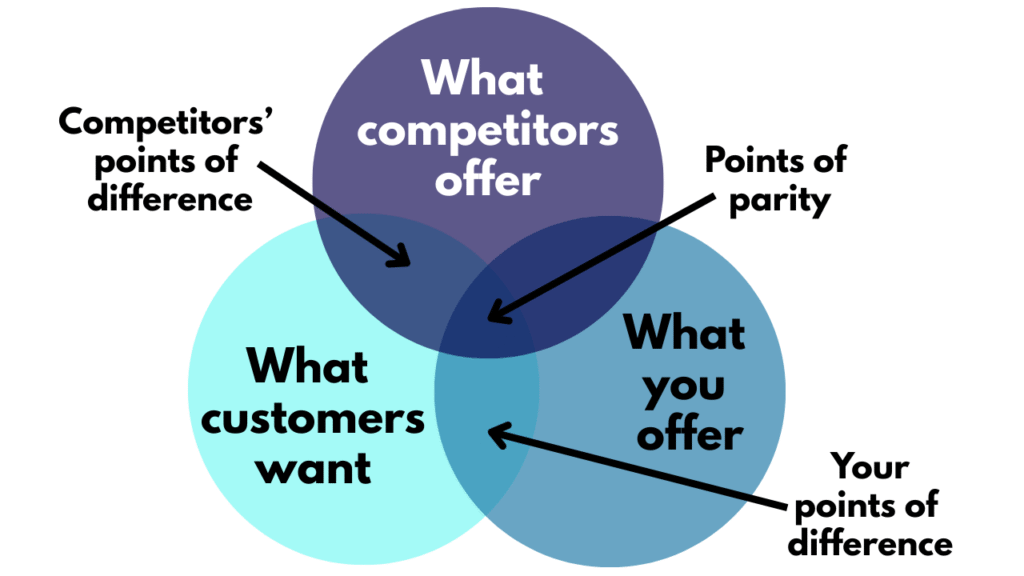
In my college marketing classes, one of the most important tools we study is the circles of a successful value proposition.Companies use it to answer a critical question: Why should customers choose us instead of the competition?
The tool uses three overlapping circles:
- What we offer
- What customers want
- What competitors offer
Where those circles overlap, we find two powerful ideas:
- Points of difference: The features or qualities that set a product apart — the reasons customers pick one option over another.
- Points of parity: The features or qualities that everyone in the market must provide just to be considered. Think of them as the “table stakes.”
When my college students learn this, they see how companies position themselves to win. But here’s the part that makes it especially relevant to you as a high school student: the same idea applies to how you position yourself.
From marketing to high school life
Think about it this way:
- Your points of parity are the basics every student is expected to deliver: showing up, doing the work, treating people with respect. Those don’t make you unique, but without them, you don’t even get considered for leadership opportunities.
- Your points of difference are what make people say, “I want to work with her” or “He would be a great leader.”Maybe you’re especially creative, dependable under pressure, or the one who pulls a team together.
Just like in business, success in school and life comes from mastering the basics and showing what sets you apart.
Why this matters for you?
College applications, team captain selections, even part-time jobs — all of these are situations where others are comparing you to other strong students. The winning position is when you can clearly show both:
“…and here’s what makes me different and valuable” (difference)
“I do the things you expect from every good student” (parity)
Try this this week
- Parity check: Write down 3 basics people can always count on you for.
- Difference check: Identify one quality that makes you stand out from most people your age.
- Practice your pitch: Try saying, “I’m like other strong students in ___, but I stand out because ___.”
I tell my college students that value propositions are at the heart of great marketing strategy. For you, they’re at the heart of building your personal brand as a student leader.
FOR PARENTS >>>
As parents, you can help your teen use this tool by encouraging them to:
- Connect to the future. Colleges and employers look for both — students who can meet the basics and bring something extra. Reinforcing this dual focus now prepares your teen to present themselves strongly later.
- Recognize parity first. Celebrate when your teen consistently meets expectations — showing up, finishing assignments, respecting others. These “basics” are easy to overlook, but they matter.
- Spot points of difference. Point out the unique qualities you notice: maybe your teen is unusually persistent, empathetic, or creative. Teens often undervalue what makes them distinctive.
- Frame it positively. When talking about strengths, encourage language like, “I’m reliable and dependable, but I also bring creative energy.” This builds confidence for interviews, leadership roles, or college essays.


